 Log In


 Log into Online Banking
What Is Social Distancing?
Social distancing is a way to keep people from interacting closely or frequently enough to spread an infectious disease. Schools and other gathering places such as movie theaters may close, and sports events and religious services may be cancelled.What Is Quarantine?
Quarantine separates and restricts the movement of people who have been exposed to a contagious disease to see if they become sick. It lasts long enough to ensure the person has not contracted an infectious disease.What Is Isolation?
Isolation prevents the spread of an infectious disease by separating people who are sick from those who are not. It lasts as long as the disease is contagious.What to Expect: Typical Reactions
Everyone reacts differently to stressful situations, such as an infectious disease outbreak, that require social distancing, quarantine, or isolation. People may feel:Anxiety, worry, or fear related to:- Their own health status
- The health status of others whom they may have exposed to the disease
- The resentment that friends and family may feel if they need to go into quarantine as a result of contact
- The experience of monitoring themselves, or being monitored by others for signs and symptoms of the disease
- Time taken off from work and the potential loss of income and job security
- The challenges of securing things they need, such as groceries and personal care items
- Concern about being able to effectively care for children or others
- Uncertainty or frustration about how long they will need to remain in this situation, and uncertainty about the future
- Loneliness associated with feeling cut off from the world and from loved ones
- Anger if they think they were exposed to the disease because of others’ negligence
- Boredom and frustration because they may not be able to work or engage in regular day-to-day activities
- Uncertainty or ambivalence about the situation
- A desire to use alcohol or drugs to cope
- Symptoms of depression, such as feelings of hopelessness, changes in appetite, or sleeping too little or too much
- Symptoms of post-traumatic stress disorder (PTSD), such as intrusive distressing memories, flashbacks (reliving the event), nightmares, changes in thoughts and mood, and being easily startled
Ways to Support Yourself during Social Distancing, Quarantine, and Isolation
Understand the Risk
Consider the real risk of harm to yourself and others around you. The public perception of risk during a situation such as an infectious disease outbreak is often inaccurate. Media coverage may create the impression that people are in immediate danger when really the risk for infection may be very low. Take steps to get the facts:- Stay up to date on what is happening, while limiting your media exposure. Avoid watching or listening to news reports 24/7 since this tends to increase anxiety and worry. Remember that children are especially affected by what they hear and see on television.
- Look to credible sources for information on the infectious disease outbreak:
Be Your Own Advocate
Speaking out about your needs is particularly important if you are in quarantine, since you may not be in a hospital or other facility where your basic needs are met. Ensure you have what you need to feel safe, secure, and comfortable.- Work with local, state, or national health officials to find out how you can arrange for groceries and toiletries to be delivered to your home as needed.
- Inform health care providers or health authorities of any needed medications and work with them to ensure that you continue to receive those medications.
Educate Yourself
Health care providers and health authorities should provide information on the disease, its diagnosis, and treatment.- Do not be afraid to ask questions—clear communication with a health care provider may help reduce any distress associated with social distancing, quarantine, or isolation.
- Ask for written information when available.
- Ask a family member or friend to obtain information in the event that you are unable to secure this information on your own.
Work With Your Employer to Reduce Financial Stress
If you’re unable to work during this time, you may experience stress related to your job status or financial situation.- Provide your employer with a clear explanation of why you are away from work.
- Contact the U.S. Department of Labor toll-free at 1 (866) 487-2365 about the Family and Medical Leave Act (FMLA), which allows U.S. employees up to twelve weeks of unpaid leave for serious medical conditions, or to care for a family member with a serious medical condition.
- Contact your utility providers, cable and Internet provider, and other companies from whom you get monthly bills to explain your situation and request alternative bill payment arrangements as needed.
Connect With Others
Reaching out to people you trust is one of the best ways to reduce anxiety, depression, loneliness, and boredom during social distancing, quarantine, and isolation. You can:- Use the telephone, email, text messaging, and social media to connect with friends, family, and others.
- Talk “face to face” with friends and loved ones using Skype or FaceTime.
- If approved by health authorities and your health care providers, arrange for your friends and loved ones to bring you newspapers, movies, and books.
- Sign up for emergency alerts via text or email to ensure you get updates as soon as they are available.
- Call the Substance Abuse and Mental Health Services Administration’s (SAMHSA) free 24-hour Disaster Distress Helpline at 1 (800) 985-5990, if you feel lonely or need support.
- Use the Internet, radio, and television to keep up with local, national, and world events.
- If you need to connect with someone because of an ongoing alcohol or drug problem, consider calling your local Alcoholics Anonymous or Narcotics Anonymous offices.
Talk to Your Doctor
If you are in a medical facility, you may have access to health care providers who can answer your questions. However, if you are quarantined at home and you’re worried about physical symptoms you or your loved ones may be experiencing, call your doctor or other health care provider.- Ask your provider whether it would be possible to schedule remote appointments via Skype or FaceTime for mental health, substance use, or physical health needs.
- In the event that your doctor is unavailable and you are feeling stressed or are in crisis, call the hotline numbers listed at the end of this tip sheet for support.
Use Practical Ways to Cope and Relax
- Relax your body often by doing things that work for you-take deep breaths, stretch, meditate or pray, or engage in activities you enjoy.
- Pace yourself between stressful activities and do something fun after a hard task.
- Talk about your experiences and feelings to loved ones and friends, if you find it helpful.
- Maintain a sense of hope and positive thinking; consider keeping a journal where you write down things you are grateful for or that are going well.
After Social Distancing, Quarantine, or Isolation
You may experience mixed emotions, including a sense of relief. If you were isolated because you had the illness, you may feel sadness or anger because friends and loved ones may have unfounded fears of contracting the disease from contact with you, even though you have been determined not to be contagious.The best way to end this common fear is to learn about the disease and the actual risk to others. Sharing this information will often calm fears in others and allow you to reconnect with them.If you or your loved ones experience symptoms of extreme stress—such as trouble sleeping, problems with eating too much or too little, inability to carry out routine daily activities, or using drugs or alcohol to cope—speak to a health care provider or call one of the hotlines listed to the right for a referral.If you are feeling overwhelmed with emotions such as sadness, depression, anxiety, or feel like you want to harm yourself or someone else, call 911 or the National Suicide Prevention Lifeline at 1 (800) 273- 8255.Helpful Resources Hotlines
Substance Abuse and Mental Health Services Administration’s (SAMHSA) Disaster Distress HelplineToll-Free: 1 (800) 985-5990 (English and español)SMS: Text TalkWithUs to 66746SMS (español): “Hablanos” al 66746TTY: 1 (800) 846-8517Website (English): http://www.disasterdistress.samhsa.govWebsite (español): https://www.samhsa.gov/find-help/disaster-distress-helpline/espanolSAMHSA’s National HelplineToll-Free: 1 (800) 662-HELP (24/7/365 Treatment Referral Information Service in English and español)National Suicide Prevention LifelineToll-Free (English): 1 (800) 273-8255Toll-Free (español): 1 (888) 628-9454TTY: 1 (800) 799-4889Treatment LocatorFor help finding treatment call 1 (800) 662-4357 or visit https://findtreatment.gov/SAMHSA Disaster Technical Assistance CenterToll-Free: 1 (800) 308-3515Email: DTAC@samhsa.hhs.govUPDATE AS OF 3/21/2020:
Given the increasing spread of COVID-19 every day here in Pennsylvania, we are closing our branch lobbies to all walk-in customers starting today.
Keep in mind, we provide many services to enable you to do your banking from home.
You may start the account opening process by submitting a deposit account application. You may also call 610-298-8811 for deposit assistance.
Also, if you have a loan question, please call 610-628-1828.
We have a full array of online banking services, enabling you to transfer money and deposit checks (via our mobile app), check your account balances, pay bills, and more.
We also urge you to use our telephone banking/Dial-A-Bank by calling 1-800-396-6137.
We thank you for your understanding and cooperation during this unusual period of time but rest assured New Tripoli Bank is here for you.
UPDATE AS OF 3/16/2020:
To our customers:
In an effort to do our part to stem the spread of coronavirus, we are closing all branch lobbies as of Monday, March 16, 2020 at 5:00 PM for an indefinite period of time.
We will continue to serve our customers through our drive-ups, ATM's, and night drops as well as through our online, mobile and telephone banking services.
If you have a CD that is coming up for renewal, changes or renewals can be made over the telephone by calling any of our offices.
If you have a need for a loan or to open an account, please contact our Claussville office to schedule an appointment.
If you are a business customer and have a need for currency or coin that can't be accommodated through the drive up, please call the Claussville office to arrange pick-up.
We will continue to process all deposit drops that come through all our office locations. The depository at Village Center ATM will stay on the same schedule as it is currently.
New Tripoli Bank has a coronavirus committee in place to monitor the COVID-19 situation on a daily basis. Our priorities are to continue to deliver the banking services you need and to keep your health and well-being as our top priority.
Important Telephone Numbers to Reach New Tripoli Bank:
Toll-Free: 1 (888) 298-8821
Claussville Office: (610) 395-8834
New Tripoli Office: (610) 298-8811
Buckeye Office: (610) 421-4001
UPDATE AS OF 3/13/2020:
To all our customers:
As coronavirus disease 2019 (COVID-19) continues to spread, the health and safety of our customers and employees is our first concern.
Please be advised that we have expanded the after-hours cleaning and disinfecting services being utilized at all of our offices. We are also routinely cleaning our teller stations, ATMs and other frequently-touched surfaces throughout the day. We are asking both our customers and our employees that, if they feel sick, to please stay home to help limit the spread of the virus.
We are consulting informational resources about the coronavirus provided by the State Department of Health, Centers for Disease Control and Prevention, the Federal Reserve System and the World Health Organization so that we may continue bank operations in a safe and effective manner.
New Tripoli Bank has many alternative means of fulfilling your banking needs from home. We strongly advise our customers to utilize our digital banking tools, ATM's, internet and mobile banking which give you 24/7 access to your account. If you haven't already downloaded our free mobile banking app, you can download from the App Store or Google Play. You can use the app to access your accounts, make payments and deposit checks without needing to visit one of our branch offices. Our online banking platform also features 24/7 customer support. We pledge to help our customers, as we always have, during periods of crisis.
Updated 3/23/2020What is coronavirus disease 2019 (COVID-19)?
Coronavirus disease 2019 (COVID-19) is a respiratory illness that can spread from person to person. The virus that causes COVID-19 is a novel coronavirus that was first identified during an investigation into an outbreak in Wuhan, China.How many cases of COVID-19 have been reported in the U.S.?
The first case of COVID-19 in the United States was reported on January 21, 2020. The current count of cases of COVID-19 in the United States is available on CDC’s webpage.How does COVID-19 spread?
Person-to-person spread
The virus is thought to spread mainly from person-to-person.- Between people who are in close contact with one another (within about 6 feet).
- Through respiratory droplets produced when an infected person coughs or sneezes.
Can someone spread the virus without being sick?
- People are thought to be most contagious when they are most symptomatic (the sickest).
- Some spread might be possible before people show symptoms; there have been reports of this occurring with this new coronavirus, but this is not thought to be the main way the virus spreads.
Spread from contact with contaminated surfaces or objects
It may be possible that a person can get COVID-19 by touching a surface or object that has the virus on it and then touching their own mouth, nose, or possibly their eyes, but this is not thought to be the main way the virus spreads.How easily the virus spreads
How easily a virus spreads from person-to-person can vary. Some viruses are highly contagious (spread easily), like measles, while other viruses do not spread as easily. Another factor is whether the spread is sustained, spreading continually without stopping.The virus that causes COVID-19 seems to be spreading easily and sustainably in the community (“community spread”) in some affected geographic areas.What are the symptoms of COVID-19?
Reported illnesses have ranged from mild symptoms to severe illness and death for confirmed coronavirus disease 2019 (COVID-19) cases.These symptoms may appear 2-14 days after exposure (based on the incubation period of MERS-CoV viruses).- Fever
- Cough
- Shortness of breath
- Trouble breathing
- Persistent pain or pressure in the chest
- New confusion or inability to arouse
- Bluish lips or face
What are severe complications from this virus?
Some patients have pneumonia in both lungs, multi-organ failure and in some cases death.What should I do if I recently traveled from an area with ongoing spread of COVID-19?
If you have traveled from an affected area, there may be restrictions on your movements for up to 2 weeks. If you develop symptoms during that period (fever, cough, trouble breathing), seek medical advice. Call the office of your health care provider before you go, and tell them about your travel and your symptoms. They will give you instructions on how to get care without exposing other people to your illness. While sick, avoid contact with people, don’t go out and delay any travel to reduce the possibility of spreading illness to others.Is there a vaccine?
There is currently no vaccine to protect against COVID-19. The best way to prevent infection is to take everyday preventive actions, like avoiding close contact with people who are sick and washing your hands often.Is there a treatment?
There is no specific antiviral treatment for COVID-19. People with COVID-19 can seek medical care to help relieve symptoms.What to do if you are sick with coronavirus disease 2019 (COVID-19)
If you are sick with COVID-19 or suspect you are infected with the virus that causes COVID-19, follow the steps below to help prevent the disease from spreading to people in your home and community.Stay home except to get medical care
- Stay home: People who are mildly ill with COVID-19 are able to recover at home. Do not leave, except to get medical care. Do not visit public areas.
- Stay in touch with your doctor. Call before you get medical care. Be sure to get care if you feel worse or you think it is an emergency.
- Avoid public transportation: Avoid using public transportation, ride-sharing, or taxis.
Separate yourself from other people and animals in your home
- Stay away from others: As much as possible, you should stay in a specific “sick room” and away from other people in your home. Use a separate bathroom, if available.
- Limit contact with pets and animals: You should restrict contact with pets and other animals, just like you would around other people.
- Although there have not been reports of pets or other animals becoming sick with COVID-19, it is still recommended that people with the virus limit contact with animals until more information is known.
- When possible, have another member of your household care for your animals while you are sick with COVID-19. If you must care for your pet or be around animals while you are sick, wash your hands before and after you interact with them. See COVID-19 and Animals for more information.
Call ahead before visiting your doctor
If you have a medical appointment, call your doctor’s office or emergency department, and tell them you have or may have COVID-19. This will help the office protect themselves and other patients.Wear a facemask
- If you are sick: You should wear a facemask when you are around other people and before you enter a healthcare provider’s office.
- If you are caring for others: If the person who is sick is not able to wear a facemask (for example, because it causes trouble breathing), then people who live in the home should stay in a different room. When caregivers enter the room of the sick person, they should wear a facemask. Visitors, other than caregivers, are not recommended.
Cover coughs and sneezes
- Cover: Cover your mouth and nose with a tissue when you cough or sneeze.
- Dispose: Throw used tissues in a lined trash can.
- Wash hands: Immediately wash your hands with soap and water for at least 20 seconds. If soap and water are not available, clean your hands with an alcohol-based hand sanitizer that contains at least 60% alcohol.
Avoid sharing personal household items
- Do not share: Do not share dishes, drinking glasses, cups, eating utensils, towels, or bedding with other people in your home.
- Wash thoroughly after use: After using these items, wash them thoroughly with soap and water or put in the dishwasher.
Clean your hands often
- Wash hands: Wash your hands often with soap and water for at least 20 seconds. This is especially important after blowing your nose, coughing, or sneezing; going to the bathroom; and before eating or preparing food.
- Hand sanitizer: If soap and water are not available, use an alcohol-based hand sanitizer with at least 60% alcohol, covering all surfaces of your hands and rubbing them together until they feel dry.
- Soap and water: Soap and water are the best option, especially if hands are visibly dirty.
- Avoid touching: Avoid touching your eyes, nose, and mouth with unwashed hands.
Avoid close contact
- Avoid close contact with people who are sick
- Put distance between yourself and other people if COVID-19 is spreading in your community. This is especially important for people who are at higher risk of getting very sick.
Clean and disinfect
- Clean AND disinfect frequently touched surfaces daily. This includes tables, doorknobs, light switches, countertops, handles, desks, phones, keyboards, toilets, faucets, and sinks.
- If surfaces are dirty, clean them: Use detergent or soap and water prior to disinfection.
- Diluting your household bleach.To make a bleach solution, mix:
- 5 tablespoons (1/3rd cup) bleach per gallon of waterOR
- 4 teaspoons bleach per quart of water
- Alcohol solutions.Ensure solution has at least 70% alcohol.
- Other common EPA-registered household disinfectants.Products with EPA-approved emerging viral pathogens pdf icon[7 pages]external icon claims are expected to be effective against COVID-19 based on data for harder to kill viruses. Follow the manufacturer’s instructions for all cleaning and disinfection products (e.g., concentration, application method and contact time, etc.).
Monitor your symptoms
- Seek medical attention, but call first: Seek medical care right away if your illness is worsening (for example, if you have difficulty breathing).
- Call your doctor before going in: Before going to the doctor’s office or emergency room, call ahead and tell them your symptoms. They will tell you what to do.
- Wear a facemask: If possible, put on a facemask before you enter the building. If you can’t put on a facemask, try to keep a safe distance from other people (at least 6 feet away). This will help protect the people in the office or waiting room.
- Follow care instructions from your healthcare provider and local health department: Your local health authorities will give instructions on checking your symptoms and reporting information.
- Difficulty breathing or shortness of breath
- Persistent pain or pressure in the chest
- New confusion or inability to arouse
- Bluish lips or face
Discontinuing home isolation
- People with COVID-19 who have stayed home (home isolated) can stop home isolation under the following conditions:
- If you will not have a test to determine if you are still contagious, you can leave home after these three things have happened:
- You have had no fever for at least 72 hours (that is three full days of no fever without the use medicine that reduces fevers)AND
- other symptoms have improved (for example, when your cough or shortness of breath have improved)AND
- at least 7 days have passed since your symptoms first appeared
- If you will be tested to determine if you are still contagious, you can leave home after these three things have happened:
- You no longer have a fever (without the use medicine that reduces fevers)AND
- other symptoms have improved (for example, when your cough or shortness of breath have improved)AND
- you received two negative tests in a row, 24 hours apart. Your doctor will follow CDC guidelines.
- If you will not have a test to determine if you are still contagious, you can leave home after these three things have happened:
Rebuilding after a disaster or emergency can be a difficult challenge for people at every level of income. In these stressful situations, having easy access to your personal financial, insurance, medical, and other records is key to beginning the rebuilding process as quickly as possible. Taking the time now to collect and protect your critical documents will pay off in the future, giving you peace of mind and, in the event of an emergency, ensure you are ready to start rebuilding as soon as possible with all the necessary information.
Look over the following list and confirm you have taken all these steps to prepare for an emergency:
- Collect all financial and critical personal, household, and medical documents and maintain it in a secure location, readily accessible.
- Establish an emergency fund that can be accessed in times of crisis. This could mean keeping a small amount of cash at home in a secure place in case you can't get access to your bank accounts.
- Obtain property (homeowners or renters), health, and life insurance if you do not have them already. Review your policy to ensure you're covered in the event of all possible emergencies. For example: standard homeowners insurance often will not cover flooding, so you may need to purchase separate flood insurance from the National Flood Insurance Program.
- Make photo copies of all of your debit and credit cards and store them in a safe place so you have your account information at the ready in the event of an emergency.
- FEMA has an Emergency Financial First Aid Kit (EFFAK) with a wealth of information to help you prepare your emergency financial plan.
Emergency Financial First Aid Kit (EFFAK)
If there's anything we want you to take away from this article, it's how important it is to have a financial plan ready for an emergency. FEMA's Emergency Financial First Aid Kit (EFFAK) can help you prepare for surprises and reduce the financial impact of disasters that could otherwise hurt you, your family, or your business.
At Home
The EFFAK is an excellent guide to ensuring your personal financial preparedness, but you should also consider downloading a secure mobile app on your phone where you can store electronic copies of important documents for immediate access in the case of an emergency. You should also consider storing physical documents in a safe deposit box at your local financial institution if they offer those services.
The most important documents to have in an emergency are your financial and medical records which are critical to jump-start the recovery process. Take the time to make sure you have the following documents secured and accessible in the event of a disaster:
Household Identification
- Photo ID of all household residents
- Birth certificates
- Social Security card to apply for disaster assistance from FEMA
- Military service
- Pet ID tags
Financial and Legal Documentation
- Financial records and obligations
- Insurance policies
- Sources of income to maintain payments and credit
- Tax statements to provide contact information and apply for FEMA assistance
Medical Information
- Physician contact information in case medical care is needed
- Copies of health insurance information so care is not interrupted
- Immunization records
- Medication
Insurance Information
Purchasing insurance for your home or business property helps ensure you have the financial resources necessary to repair, rebuild, or replace whatever is damaged.
Household Contact Information
- Banking institutions
- Insurance agent
- Health professionals
- Service providers
- Place of worship
For Organizations
Businesses and other organizations are only as strong as their employees, which is why an employee or member's financial stress can have a ripple effect that could negatively impact your organization. You should encourage people throughout your organization or workplace to practice financial preparedness. Here are some ideas you can use to help promote emergency preparedness in your business or organization:
- Hold an informal lunch meeting to discuss financial preparedness.
- Organize a presentation for your next staff meeting.
- Include financial preparedness tips in your monthly staff newsletter.
Get Your Benefits Electronically
Disasters can disrupt mail service for days or even weeks at a time. If you rely on Social Security, pensions, or other regular benefits, you should consider switching to electronic payments to ensure your income is not interrupted by an emergency. This also eliminates the risk of checks being stolen from the mail. We recommend you consider these methods of payment instead of receiving physical mail:
- Set up direct deposit to your checking or savings account. Federal benefit recipients can sign up online or call (800) 333-1795.
- The Direct Express® prepaid debit card is designed as a safe and easy alternative to paper.
These tips and suggestions were taken from the Department of Homeland Security’s Financial Preparedness. You can learn more about how to prepare for disasters by visiting Ready.gov
New Tripoli Bank has donated $5,000 to the Weisenberg Volunteer Fire Company to assist in their mission to provide fire protection, emergency response, and medical assistance to Weisenberg Township and surrounding municipalities.
This donation will go toward helping the Fire Company maintain and upgrade their equipment and firehouse, recruit and train new volunteer firefighters, and support community events that the Fire Company runs year-round.
New Tripoli Bank is a proud supporter of the Weisenberg Fire Company and urges others to lend their support to this vital volunteer organization.

Pictured left to right: Jeffrey Broadhurst, Weisenberg Volunteer Fire Company Treasurer; Mike Koch, New Tripoli Bank Assistant Branch Manager for the Buckeye Office
New Tripoli Bank has donated $5,000 to the Fogelsville Volunteer Fire Company to assist in their mission to provide emergency services and training to our community.
This donation will go toward helping the Fire Company train new volunteers, maintain and upgrade their facility and equipment, and support community events that the Fire Company runs year-round.
New Tripoli Bank is a proud supporter of the Fogelsville Fire Company and urges others to lend their support to this important volunteer organization.
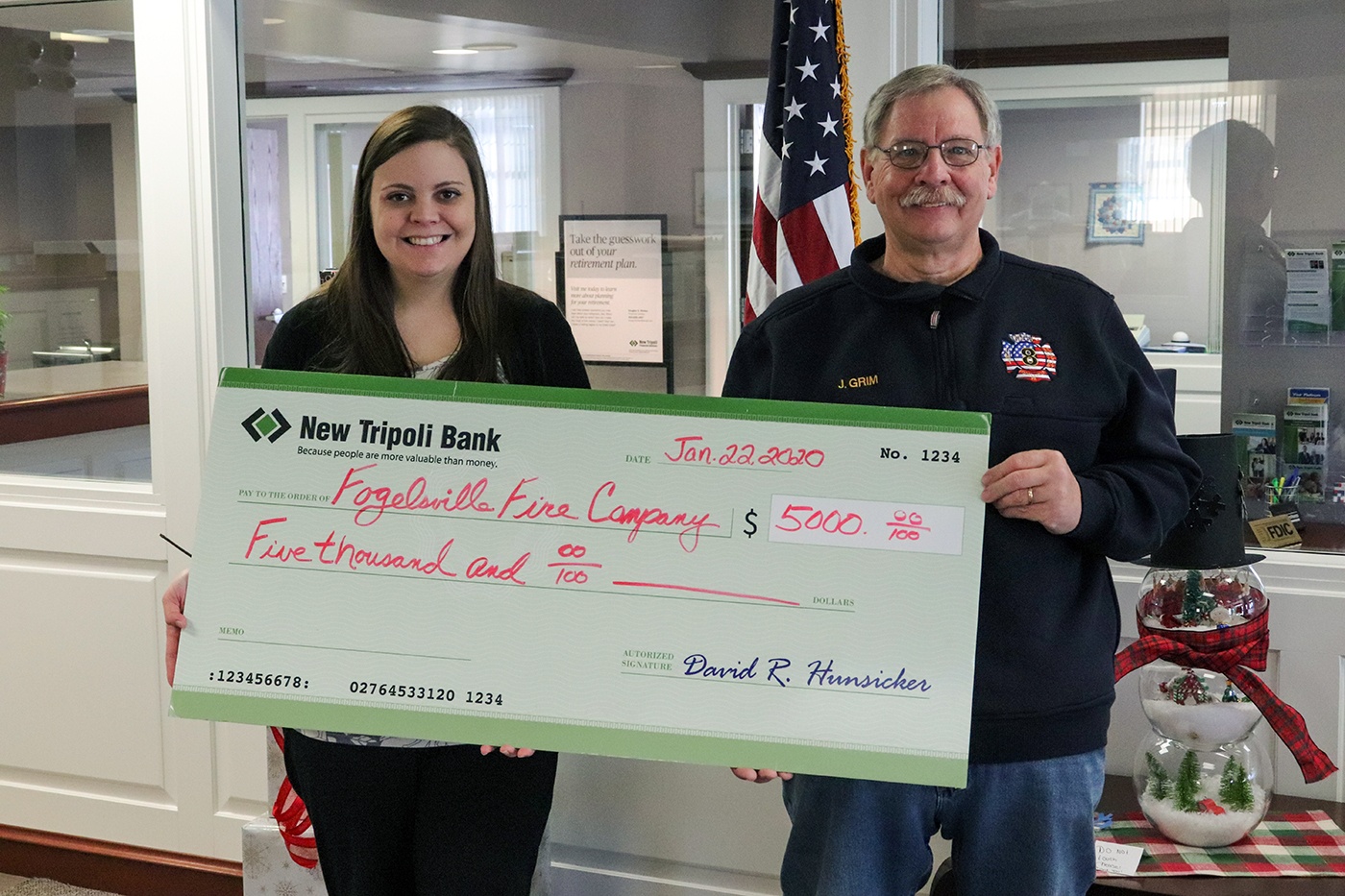
Pictured from left to right: Beth-Ann May, Assistant Branch Manager for the Claussville Office; Jeffrey Grim, Fogelsville Fire Company President
New Tripoli Bank donated $10,000 to the Northern Valley EMS, Inc. (NOVA) in recognition of the important role this organization plays in the health of our community.
NOVA provides non-profit emergency medical services to Walnutport, Slatington, and the Townships of North Whitehall, Washington, Heidelberg, and areas of Lowhill in Lehigh County. They operate year-round, 24-hour ambulance services to our community. They also provide emergency response training and education programs.
New Tripoli Bank is a proud supporter of NOVA and urges support for this important non-profit organization.

Pictured from left to right: John Hayes, New Tripoli Bank Executive VP and Chief Lending Officer; David Hunsicker, New Tripoli Bank President and CEO; Kristie Wilk, NOVA Executive Director; Jason Bredinger, NOVA Board of Trustees
New Tripoli Bank donated $10,000 to the Cetronia Ambulance Corps in recognition of the important role this organization plays in the health of our community.
Cetronia Ambulance Corps is the largest community-based non-profit ambulance service in Eastern PA, answering more than 60,000 calls a year and providing 911 service to more than 100,000 residents. They also provide emergency response training and education programs.
New Tripoli Bank is a proud supporter of the Cetronia Ambulance Corps and urges support for this important non-profit organization.

Pictured from left to right: Bob Mateff, Cetronia Ambulance COO; Andrew Wirth, Paramedic; Keri Miller, Paramedic; Dave R. Hunsicker, New Tripoli Bank President & CEO; Larry Wiersch, Cetronia Ambulance CEO; John Hayes, New Tripoli Bank Executive Vice President & CLO; Zach Bath, EMT; Brandon Selig, EMT
As we say good-bye to the last decade and hello to 2020, it’s even more important to focus on planning for tomorrow. One of the best New Year’s resolutions you can make for yourself is to start establishing good credit habits and set financial wellness goals for yourself that will help you get back on the path to a prosperous financial future.
If personal finances are a house, then having good credit is the foundation. Whether your plan is to purchase a new home or start your own small business, you’ll need a loan to get there, and you won’t be able to get one without good credit!
Like anything in life, responsible credit practices are not something anyone is naturally good at. You have to work toward developing habits that demonstrate sound money management strategy. Remember; it’s much easier to build a credit score than repair a damaged one.
Enough introduction: what can you do to avoid costly missteps as you start on your journey to building and maintaining good credit?
- If you are just beginning to establish your credit history, open a checking account with your local community bank and make a habit out of keeping track of your balance. New Tripoli Bank has a free checking account to get you started and money management tools in our online banking platform.
- Instead of cash, use debit and credit cards for convenience and safety. However, make sure you don’t overspend! Missed or late payments can be damaging to your credit and will end up hurting your credit score.
- Try to maintain a varied mix of credit types (such as a revolving line of credit or an installment loan). Utilizing different types of credit shows your ability to manage your finances and will boost your credit score.
- Three to six months prior to making a major purchase, you should take extra care to demonstrate financial stability. Loan officers will feel more comfortable lending to you if you aren't opening and closing accounts or moving large amounts of money around, and avoiding these practices can mitigate stress after a large purchase.
- Build an emergency fund equal to at least six months of living expenses. That way, if the unexpected happens, you will still be able to pay fixed expenses without falling behind.
- As you reach different stages of life, you should alter your credit focus. Early in life you can take out loans on larger purchases such as automobiles and real estate, which will help you build credit, but as you near retirement you will want to make sure these major loans are paid down.
- Monitor your credit regularly to correct any errors and quickly detect signs of potential identity theft. Order a copy of your annual credit report from annualcreditreport.com. You can also sign up for credit monitoring services that will help protect your credit.
If you’re concerned about your credit or want help achieving financial milestones, you should contact your local community bank who is always ready to assist. Maintaining good spending and saving habits early can help you focus on your financial goals and make it easier for you to navigate life’s unexpected twists and turns.
New Tripoli Bank is happy to announce that Donna Sigley has been promoted to Vice President, Mortgage Loan Officer for New Tripoli Bank.
Donna has been interested in banking for most of her life. While attending Emmaus High School, Donna enrolled in night classes at Merchants Bank to learn more about the banking industry. Prior to joining New Tripoli Bank, Donna worked as a cashier in the cafeteria at Northwestern Lehigh, a position that afforded her more personal time to spend with her husband and raising their two sons. However, Donna’s interest in banking never went away. When her sons were old enough, she applied for a job at New Tripoli Bank (where she was a customer) and started employment as a teller in February, 2001. Within a year, she was also working as a loan processor. She was promoted to Mortgage Officer in 2007 and Assistant Vice President in 2013.
Donna says her favorite part of the job is the opportunity to help customers achieve their personal financial milestones, whether it’s their first car loan, first mortgage, or simply advising customers looking to build good credit. She’s thankful for the mentorship she received from the leadership at New Tripoli Bank and her coworkers in the loan department, all of whom she credits for helping her succeed as a loan officer with New Tripoli Bank.
Congratulations to Donna on her well-deserved promotion and for being such a vital part of the New Tripoli Bank family for the last 19 years.
Next Page »« Previous Page